 Actual micrograph · Wikimedia Commons · CC BY-SA 3.0 · Source and license
Anthracnose
Colletotrichum cereale: conidia often falcate (curved), generally hyaline and single-celled; acervuli with dark setae.
An animated illustration of how fungal pathogens enter and develop within turfgrass leaf tissues
These cards compare conidia, urediniospores, hyphae and other fungal structures observed in turfgrass samples. For Rhizoctonia, microscopic diagnosis relies primarily on hyphal morphology rather than spores.
Actual micrograph · Wikimedia Commons · CC BY-SA 3.0 · Source and licenseColletotrichum cereale: conidia often falcate (curved), generally hyaline and single-celled; acervuli with dark setae.
 Actual micrograph · Eric McKenzie · CC BY 3.0 AU · Source and license
Bipolaris and Drechslera spp.: elongated, multicellular conidia with transverse septa; shape and germination differ between genera.
 Actual micrograph · Tharntip Bhasabutra · CC BY 3.0 AU · Source and license
Puccinia spp.: urediniospores are typically round or oval, pigmented, with ornamented walls; teliospores have a different morphology.

Pyricularia grisea: pear-shaped conidia, generally three-celled with two transverse septa. Shape and size help with microscopic identification.

Clarireedia spp.: the photograph shows mycelium on turfgrass, not stromata. The fungus can also survive as stromata or pseudosclerotia in infected tissues; these structures are not spores.
 University of Georgia · C1265 · Fig. 1, A. Martínez
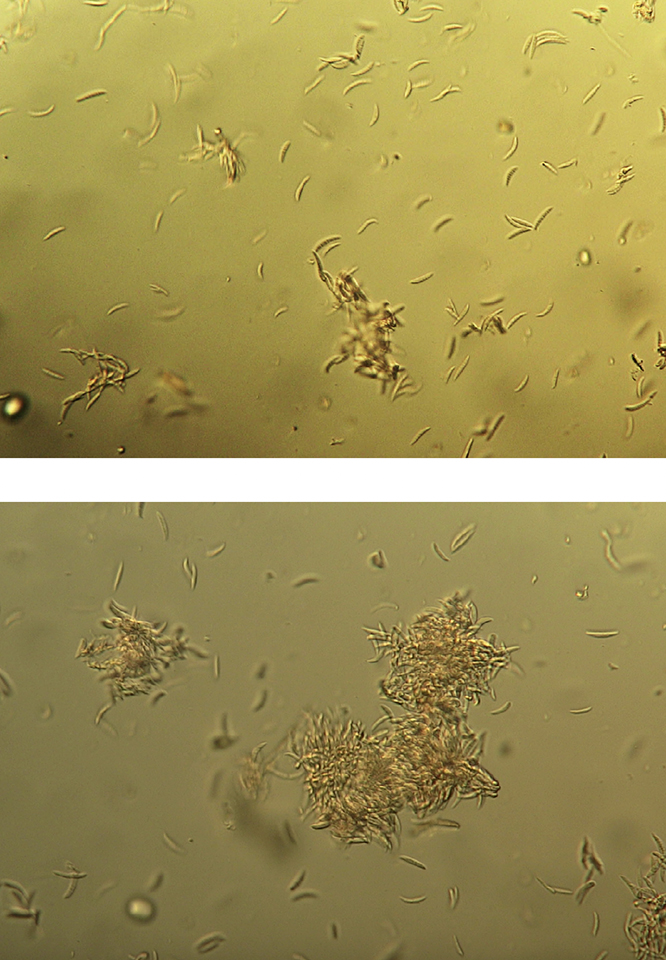
Hyaline asexual conidia, often slightly curved, visible under a microscope. The pathogen causes Microdochium patch (formerly Fusarium patch) and pink snow mold.
 University of Georgia · C1088 · Fig. 4 (hyphae on tissues)
Septate hyphae with branches forming angles close to 90°, constriction at the branch base and a septum near the branching point. It does not normally produce conidia on infected tissues.
Note: Pythium spp. is an oomycete, not a true fungus; it has structures such as sporangia, oospores and, in certain species and conditions, zoospores. It is not included in the classification of fungi shown here.