1 · Soil Observations
Penetration resistance also depends on moisture: compare measurements taken under similar conditions.
2 · Agronomic Interpretation
FIFA assessment based on the official “Compaction severity” table; it is not pitch certification. Moisture conditions and the measurement method must be verified.
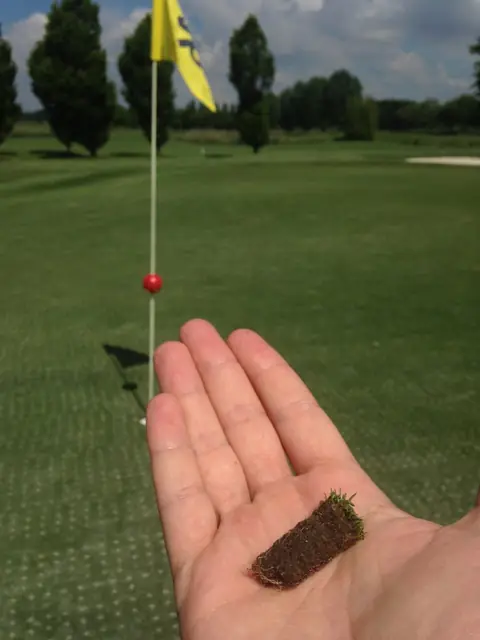
Comparison of Techniques
Punte cave: estraggono carote e possono essere impiegate in programmi di gestione del profilo.
Solid tines: create holes without removing soil; their effect also depends on lateral soil displacement.
Deep decompaction: works at greater depth when the location of the compacted layer and soil conditions justify the intervention.
Schedule operations during active growth with adequate recovery potential, avoiding saturated soils and severe stress.
3 · Aeration Hole Geometry Simulator
Confronta configurazione standard, Alta Densità / Mini-Tines (3,4 × 3,8 cm) e impostazioni personalizzate. The two spacings are independent.
Top view: regular rectangular grid. Illustration only.
Volume is calculated using nominal tine diameter as core diameter and assuming complete cylinders; actual volume may differ. Solid tines do not remove soil. The percentage of perforated surface does not measure the reduction in compaction.
Official FIFA Reference — Penetration Resistance
Intervalli di valutazione per il parametro Compaction severity nel FIFA Natural-Pitch Rating System (maggio 2022). Assessment differs between cool-season and warm-season turfgrasses.
| Rating | C3 | C4 |
|---|---|---|
| Excellent · 10 | 1,50–2,50 MPa | 1,50–3,00 MPa |
| Good · 7 | 2,51–4,00 MPa | 3,01–4,00 MPa |
| Satisfactory · 5 | 4,01–6,00 MPa | 4,01–6,00 MPa |
| Poor · 3 | 6,01–7,00 MPa | 6,01–7,00 MPa |
| Unacceptable · 1 | <1,50 o >7,00 MPa | <1,50 o >7,00 MPa |
To avoid gaps between ranges, the calculation uses continuous boundary values: for example, 2.505 MPa already falls in the next category. This assessment does not replace the FIFA sampling protocol.
Official FIFA document — Natural-Pitch Rating System, p. 6 ↗
4 · Seasonal Planning
Cool-season turfgrasses (C3)
Prefer periods of vigorous growth, typically spring and early autumn in temperate Northern Hemisphere climates.
Warm-season turfgrasses (C4)
Prefer active growth in the warm season, avoiding the onset of dormancy and stressful conditions.
These windows are indicative and depend on species, climate, soil moisture, traffic, and operation intensity. For a location-specific climate-based trend, see Green Assistant’s Growth Potential Curves (C3 and C4).
5 · Link to Thatch Management
Core aeration can support organic matter management programs and improvements in the physical properties of the soil profile. Not all aeration operations remove thatch, and not every infiltration problem is caused by compaction.
Scientific Insight — Pearl® Phosphorus and Root Development
Pearl® technology uses recovered struvite, a source of phosphorus, magnesium, and nitrogen that dissolves gradually under favorable conditions near roots. It is also used in the Sierrablen Plus Pearl range, including the Turf Starter 5-28-0 formulation.
A study conducted at Bangor University compared struvite-based phosphorus sources with monoammonium phosphate in turfgrass trials. Under the experimental conditions, struvite use and phosphorus placement in the root zone were associated with differences in root mass. These results do not show that core aeration alone produces the same effect.
Phosphorus is an essential nutrient, but its application does not necessarily increase rooting when soil availability is already adequate. Any application should be assessed against soil-test results, pH, turfgrass requirements, and renovation objectives.
Read the ICL scientific article — Understanding Pearl: Recycled Phosphorus for Turf ↗
No packaging photographs or commercial links: this informational article is separate from the simulator.