
COOL-SEASON SPECIES
C3 Photosynthesis
Explore the light-dependent reactions and the Calvin cycle. Examples: Lolium, Poa, Festuca and Agrostis.
Open C3 animation →Discover how plants convert light into chemical energy. Explore interactive animations of the C3 and C4 photosynthetic pathways, with examples of species used in turfgrass.
Explore the light-dependent reactions and the Calvin cycle. Examples: Lolium, Poa, Festuca and Agrostis.
Open C3 animation →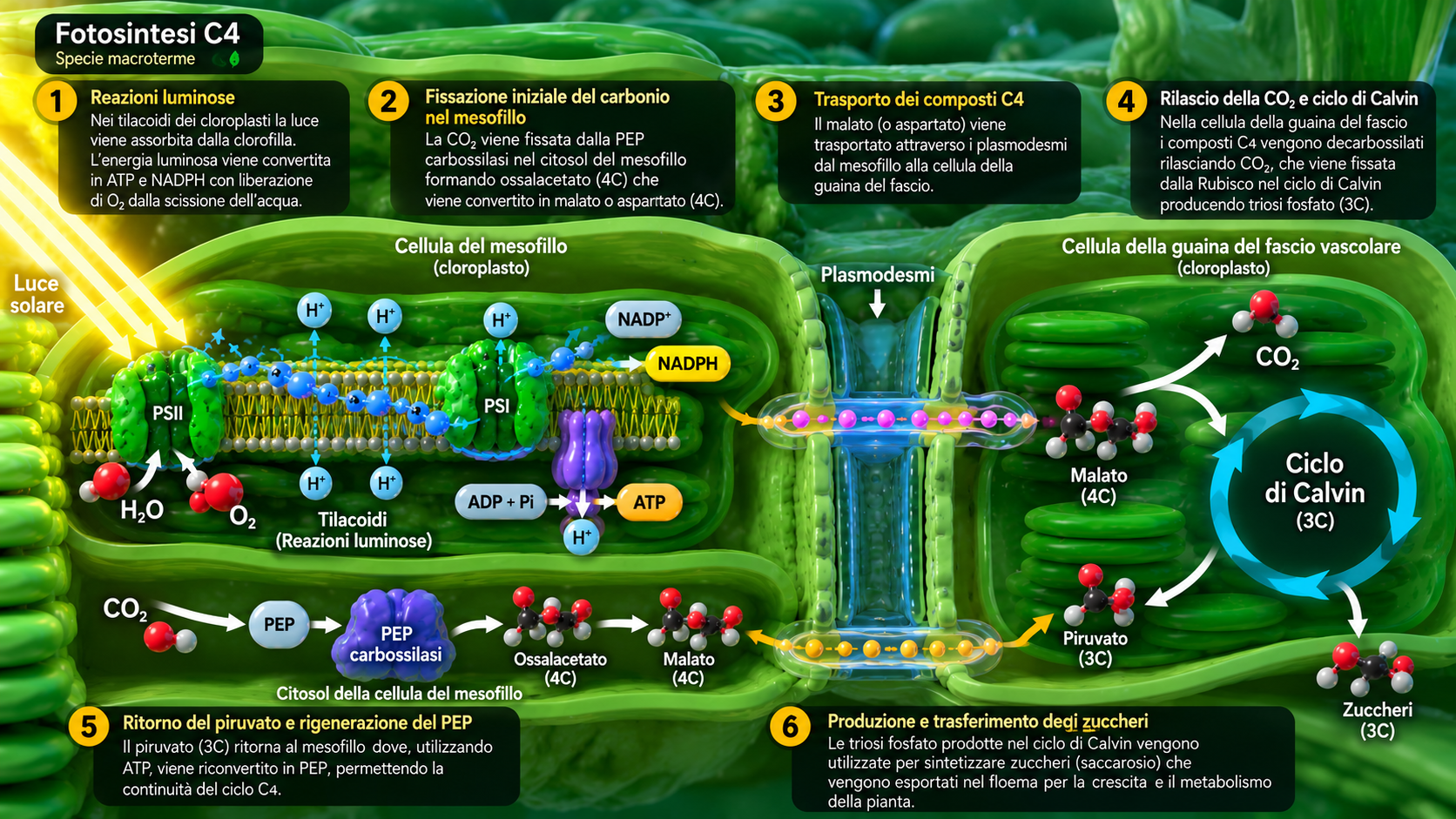
Follow initial CO₂ fixation, transport to the bundle sheath and the Calvin cycle. Examples: Cynodon and Zoysia.
Open C4 animation →In C3 plants, CO₂ is initially fixed by Rubisco in the Calvin cycle. In C4 plants, initial fixation occurs through PEP carboxylase in the mesophyll, while the Calvin cycle operates mainly in the bundle sheath.
An experimental study presented by ICL evaluated the effect of a single combined application of MTU® and pidolic acid on the quality and physiological responses of Agrostis stolonifera under reduced water availability.
The experiment was conducted in a greenhouse using turfgrass samples collected from a putting green. For 21 days, plants were maintained at three irrigation levels (100%, 75% and 50% of pot capacity). The MTU® and pidolic acid treatment was compared with an untreated control and a seaweed extract; applications were made to the root zone.
Source: ICL Growing Solutions, “MTU® and pidolic acid under drought stress”, University of Pisa trial (2025).